 Add to Chrome
 Add to Firefox
 Add to Edge
Information-theoretic Multimodal Representation Learning for Electrocardiogram Signals
May 26, 2026
Electrocardiograms (ECGs) are widely used non-invasive measurements of cardiac activity and play a central role in clinical diagnosis. Recent multimodal approaches align ECG signals with clinical reports to incorporate diagnostic semantics, but clinical reports often fail to preserve the rich physiological structure of ECG waveforms, particularly across multiple levels of abstraction ranging from coarse diagnostic categories to fine-grained morphology. To address this limitation, we formulate ECG representation learning from an information-theoretic perspective and derive a tractable objective that jointly preserves signal structure and integrates clinical semantics. Based on this principle, we propose \textbf{MERIT} (Multimodal ECG Representation via Information Theory), a dual-branch pretraining framework combining masked ECG modeling with ECG--text contrastive alignment. Extensive experiments on PTB-XL and additional benchmarks demonstrate consistent improvements over prior methods, including gains exceeding $3%$ F1 on PTB-XL All and $5%$ F1 on SubClass classification. In zero-shot evaluation, MERIT further improves performance by up to $ +2.66\%$ AUC and $ +2.11\%$ F1 on PTB-XL SubClass, while also demonstrating robustness under multiple distribution-shift settings. Moreover, leveraging the learned ECG representations for ECG-conditioned clinical text generation with large language models improves text quality across several metrics, including ROUGE and METEOR. Together, these results demonstrate that MERIT learns more informative and clinically meaningful ECG representations, particularly for fine-grained clinical applications.

FrontierOR: Benchmarking LLMs' Capacity for Efficient Algorithm Design in Large-Scale Optimization
May 26, 2026Large language models (LLMs) are increasingly used for optimization modeling and solver-code generation, yet practical operations research and optimization problems often require a harder capability: designing scalable algorithms that exploit problem structure and outperform direct formulation-and-solve baselines. Existing benchmarks are limited to small or simplified examples far below real-world scale and complexity. We introduce FrontierOR, among the first benchmarks to systematically evaluate LLM-based efficient algorithm design for realistic large-scale optimization problems. FrontierOR includes 180 tasks derived from methodologically diverse papers published in top-tier operations research venues, each with standardized instances and a hidden, expert-verified evaluation suite. We evaluate seven LLMs spanning frontier, cost-effective, and open-source models both in one-shot and test-time evolution settings. The results reveal that frontier models still struggle to move from executable formulations to efficient optimization algorithms: the strongest one-shot model outperforms Gurobi in only 31% of cases in both solution quality and computational efficiency, and even strong coding agents with test-time evolution achieve only 50% on selected hard tasks. FrontierOR establishes a practical evaluation platform for LLM-based optimization algorithm design, which enables future LLMs and agents to be systematically tested on whether they can move beyond correct formulation toward a feasible, high-quality, and efficient algorithm.
PaintCopilot: Modeling Painting as Autonomous Artistic Continuation
May 20, 2026We present PaintCopilot, a co-creative neural painting assistant that models painting as an open-ended autoregressive artistic behavior conditioned on evolving canvas states and prior brushstroke history, without requiring a target image. Unlike existing neural painting methods that frame painting as pixel reconstruction toward a predefined reference, PaintCopilot predicts future strokes directly from learned artistic dynamics, analogous to how large language models continue text sequences from prior context. The framework proposes three complementary models: a ViT-based Target Predictor that infers artist intent from partial canvas observations, an autoregressive Next Stroke Predictor that generates temporally coherent brushstrokes via flow matching, and a VAE-based Region Sampler that synthesizes semantically localized stroke sequences on demand. Built on three differentiable brush representations (Hard Round, Brush Tip, and 2D Gaussian), the system supports four interactive workflows: Optimize History, Stroke Completion, Region Inpainting, and Dynamic Brush. Through case studies with professional artists, we demonstrate that PaintCopilot enables fluid co-creative painting workflows in which artists and AI continuously alternate control throughout the creative process.
NeuroAtlas: Benchmarking Foundation Models for Clinical EEG and Brain-Computer Interfaces
May 14, 2026Foundation models (FMs) promise to extract unified representations that generalize across downstream tasks. They have emerged across fields, including electroencephalography (EEG), but it is less clear how effective they are in this particular field. Published evaluations differ in datasets, in the EEG-specific preprocessing that might influence reported results, and in the reported metrics, frequently obscuring the clinical relevance in EEG. We introduce NeuroAtlas, the largest EEG benchmark to date: 42 datasets and 260k hours covering clinical EEG (epilepsy, sleep medicine, brain age estimation) and brain-computer interfaces, and include multiple datasets per task along with bespoke clinical evaluation metrics. Besides evaluating EEG-FMs with respect to supervised baselines, we present results from generic time-series FMs. We report three findings. First, EEG-specific FMs do not consistently outperform time-series FMs, which have neither EEG-focused architectures nor been pretrained on EEG. Second, standard machine learning metrics are insufficient to assess clinical utility: thus, we thoroughly evaluate more appropriate measures such as the quality of event-level decision-making, hypnogram-derived features, and the brain-age gap in the domains of epilepsy, sleep, and brain age, respectively. Third, model rankings and performance can vary substantially within domains. We conclude that pretrained models perform largely on par, with only narrow advantages for a few, and that current models do not yet deliver on the promise of an out-of-the-box unified EEG model. NeuroAtlas exposes this gap and provides the datasets and metrics for the next generation of unified EEG FMs.
CORAL: Towards Autonomous Multi-Agent Evolution for Open-Ended Discovery
Apr 02, 2026Large language model (LLM)-based evolution is a promising approach for open-ended discovery, where progress requires sustained search and knowledge accumulation. Existing methods still rely heavily on fixed heuristics and hard-coded exploration rules, which limit the autonomy of LLM agents. We present CORAL, the first framework for autonomous multi-agent evolution on open-ended problems. CORAL replaces rigid control with long-running agents that explore, reflect, and collaborate through shared persistent memory, asynchronous multi-agent execution, and heartbeat-based interventions. It also provides practical safeguards, including isolated workspaces, evaluator separation, resource management, and agent session and health management. Evaluated on diverse mathematical, algorithmic, and systems optimization tasks, CORAL sets new state-of-the-art results on 10 tasks, achieving 3-10 times higher improvement rates with far fewer evaluations than fixed evolutionary search baselines across tasks. On Anthropic's kernel engineering task, four co-evolving agents improve the best known score from 1363 to 1103 cycles. Mechanistic analyses further show how these gains arise from knowledge reuse and multi-agent exploration and communication. Together, these results suggest that greater agent autonomy and multi-agent evolution can substantially improve open-ended discovery. Code is available at https://github.com/Human-Agent-Society/CORAL.
AromaGen: Interactive Generation of Rich Olfactory Experiences with Multimodal Language Models
Apr 02, 2026Smell's deep connection with food, memory, and social experience has long motivated researchers to bring olfaction into interactive systems. Yet most olfactory interfaces remain limited to fixed scent cartridges and pre-defined generation patterns, and the scarcity of large-scale olfactory datasets has further constrained AI-based approaches. We present AromaGen, an AI-powered wearable interface capable of real-time, general-purpose aroma generation from free-form text or visual inputs. AromaGen is powered by a multimodal LLM that leverages latent olfactory knowledge to map semantic inputs to structured mixtures of 12 carefully selected base odorants, released through a neck-worn dispenser. Users can iteratively refine generated aromas through natural language feedback via in-context learning. Through a controlled user study ($N = 26$), AromaGen matches human-composed mixtures in zero-shot generation and significantly surpasses them after iterative refinement, achieving a median similarity of 8/10 to real food aromas and reducing perceived artificiality to levels comparable to real food. AromaGen is a step towards real-world interactive aroma generation, opening new possibilities for communication, wellbeing, and immersive technologies.
OmniSapiens: A Foundation Model for Social Behavior Processing via Heterogeneity-Aware Relative Policy Optimization
Feb 11, 2026To develop socially intelligent AI, existing approaches typically model human behavioral dimensions (e.g., affective, cognitive, or social attributes) in isolation. Although useful, task-specific modeling often increases training costs and limits generalization across behavioral settings. Recent reasoning RL methods facilitate training a single unified model across multiple behavioral tasks, but do not explicitly address learning across different heterogeneous behavioral data. To address this gap, we introduce Heterogeneity-Aware Relative Policy Optimization (HARPO), an RL method that balances leaning across heterogeneous tasks and samples. This is achieved by modulating advantages to ensure that no single task or sample carries disproportionate influence during policy optimization. Using HARPO, we develop and release Omnisapiens-7B 2.0, a foundation model for social behavior processing. Relative to existing behavioral foundation models, Omnisapiens-7B 2.0 achieves the strongest performance across behavioral tasks, with gains of up to +16.85% and +9.37% on multitask and held-out settings respectively, while producing more explicit and robust reasoning traces. We also validate HARPO against recent RL methods, where it achieves the most consistently strong performance across behavioral tasks.
A Vision for Multisensory Intelligence: Sensing, Synergy, and Science
Jan 08, 2026Our experience of the world is multisensory, spanning a synthesis of language, sight, sound, touch, taste, and smell. Yet, artificial intelligence has primarily advanced in digital modalities like text, vision, and audio. This paper outlines a research vision for multisensory artificial intelligence over the next decade. This new set of technologies can change how humans and AI experience and interact with one another, by connecting AI to the human senses and a rich spectrum of signals from physiological and tactile cues on the body, to physical and social signals in homes, cities, and the environment. We outline how this field must advance through three interrelated themes of sensing, science, and synergy. Firstly, research in sensing should extend how AI captures the world in richer ways beyond the digital medium. Secondly, developing a principled science for quantifying multimodal heterogeneity and interactions, developing unified modeling architectures and representations, and understanding cross-modal transfer. Finally, we present new technical challenges to learn synergy between modalities and between humans and AI, covering multisensory integration, alignment, reasoning, generation, generalization, and experience. Accompanying this vision paper are a series of projects, resources, and demos of latest advances from the Multisensory Intelligence group at the MIT Media Lab, see https://mit-mi.github.io/.
Propose, Solve, Verify: Self-Play Through Formal Verification
Dec 20, 2025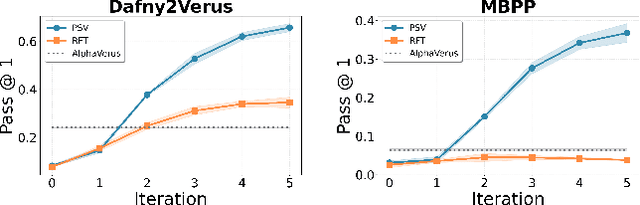
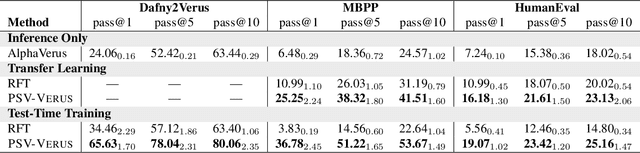
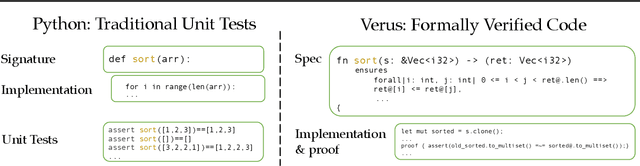

Training models through self-play alone (without any human data) has been a longstanding goal in AI, but its effectiveness for training large language models remains unclear, particularly in code generation where rewards based on unit tests are brittle and prone to error propagation. We study self-play in the verified code generation setting, where formal verification provides reliable correctness signals. We introduce Propose, Solve, Verify (PSV) a simple self-play framework where formal verification signals are used to create a proposer capable of generating challenging synthetic problems and a solver trained via expert iteration. We use PSV to train PSV-Verus, which across three benchmarks improves pass@1 by up to 9.6x over inference-only and expert-iteration baselines. We show that performance scales with the number of generated questions and training iterations, and through ablations identify formal verification and difficulty-aware proposal as essential ingredients for successful self-play.
When Reasoning Meets Its Laws
Dec 19, 2025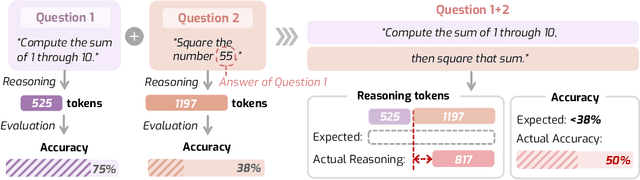
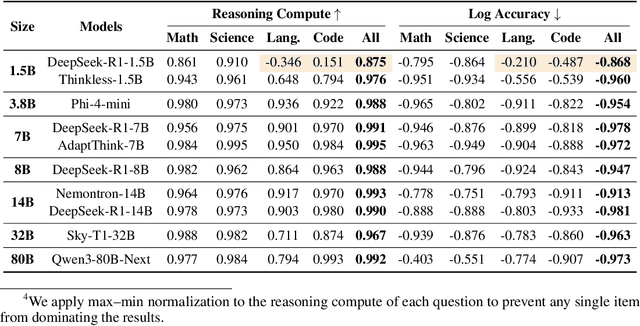
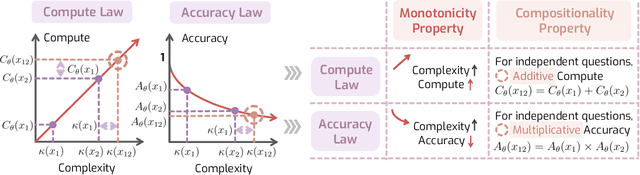
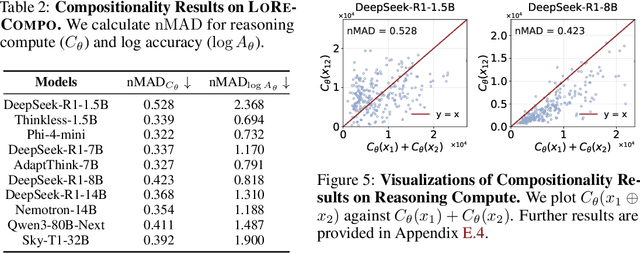
Despite the superior performance of Large Reasoning Models (LRMs), their reasoning behaviors are often counterintuitive, leading to suboptimal reasoning capabilities. To theoretically formalize the desired reasoning behaviors, this paper presents the Laws of Reasoning (LoRe), a unified framework that characterizes intrinsic reasoning patterns in LRMs. We first propose compute law with the hypothesis that the reasoning compute should scale linearly with question complexity. Beyond compute, we extend LoRe with a supplementary accuracy law. Since the question complexity is difficult to quantify in practice, we examine these hypotheses by two properties of the laws, monotonicity and compositionality. We therefore introduce LoRe-Bench, a benchmark that systematically measures these two tractable properties for large reasoning models. Evaluation shows that most reasoning models exhibit reasonable monotonicity but lack compositionality. In response, we develop an effective finetuning approach that enforces compute-law compositionality. Extensive empirical studies demonstrate that better compliance with compute laws yields consistently improved reasoning performance on multiple benchmarks, and uncovers synergistic effects across properties and laws. Project page: https://lore-project.github.io/